Treating claimants ‘right’ means many different things to modern carriers and the pressure of meeting ethical, moral, and regulatory demands can make this a complex issue to wade through.
To add more pain to this point, more claimants are experiencing pressure on their financial security than ever before. Carriers are now trying to balance emotional turbulence, external pressure, and their own capacity in an environment fraught with risk.
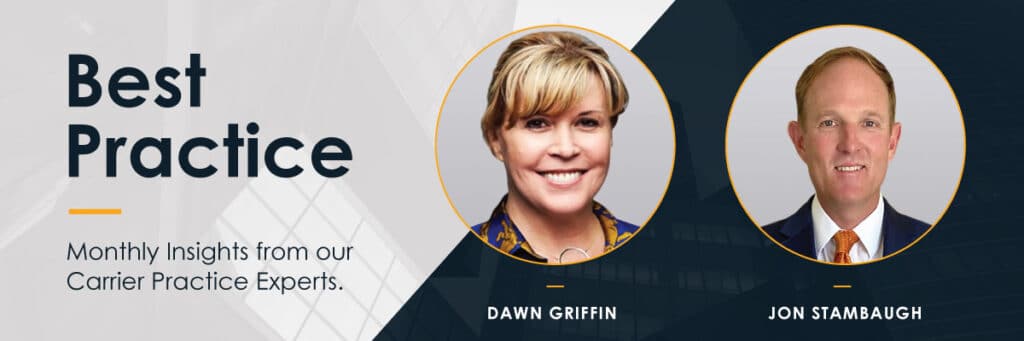
Gallagher Bassett Senior Vice President Business Development & Sales – Carrier Practice, Jon Stambaugh and Senior Vice President Claims Operations – Carrier Practice, Dawn Griffin, have put pen to paper on the way forward for carriers.
Q: Why is behaving ‘ethically’ so important for carriers?
GRIFFIN: Insurance is all about trust, and the way to maintain that trust is through ethical decisions. To start, carriers must build their trust and credibility to ensure customers will confidently hand over control of what happens when the worst happens to their business. Buying insurance from a Carrier involves a business determining whether they feel aligned to the carrier’s brand, reputation and all other factors that play into whether their behavior is perceived as ethically appropriate and fulfilling the insurance policy commitments.
It’s an interesting dynamic as the underwriters at a Carrier may have limited interaction with a policyholder or their broker until a significant event occurs. A significant event can include a unique claim, a change to the insured’s risk profile, or a renewal of their polity. It’s at these moments that an insured or their broker may talk about a carriers’ ethical framework
STAMBAUGH: ‘Ethics’ is more than just a topical concept, it’s incredibly layered and plays out for both internal and external stakeholders. Behaving ‘ethically’ means making a values-based choice at each turn.
Whether it’s striving for diverse and inclusive recruitment policies or paying a discretionary sum to a claimant undergoing extraordinarily strenuous circumstances, carriers have to make decisions each and every day, and these decisions must sit within an ethical framework. Without an ethical decision-making framework, carriers run the risk of their business’ values and purpose, and ultimately success, falling over.
Q: How have ethics been handled differently in the hybrid working model?
GRIFFIN: The changes and challenges of the past twelve months have tested many corporations on their ability to persevere, in a very different environment, and in a way that supports an ongoing ethical framework. The industry has published scenarios where companies get it really wrong and face backlash for miscommunication, inappropriate initiatives and lack of timely support to customers. Those who have gotten it right, have led with their values, ethics, and people at the core of their decisions. Regardless of the medium, the key to behaving ethically in this hybrid, digitally driven environment from a media and workplace standpoint that is driven by communication.
STAMBAUGH: Communication really is key, without it we have customers or claimants uncertain and agitated about the process of the situation, compounded injuries, and higher costs. We’ve all adapted to conducting virtual assessments, answering claimants calls in a non-office environment and securing data on cloud networks but, this will all be tested as some carriers move to a hybrid model. Regardless of whether your team is at home or in the office, they need to always be ready and empowered to make decisions with your company’s values and ethics front of mind.
Q: What are the impacts of neglecting ethical decision-making?
GRIFFIN: Behaving ethically is at its essence a grey space, reliant on context, perspective, prior knowledge, and other societal factors. It can be dangerously easy to get it wrong if you aren’t committed to living and breathing ethics each day, and the backlash can be extremely limiting. Whether it’s negative media coverage of a claim resolution, boycotting or policy withdrawals, the costs of ethical mistakes are real. It requires internal controls and a commitment to controls as a part of your operation which translates in to your market reputation.
STAMBAUGH: Your reputation can be built and destroyed by your ethical decision making. The reputational risks of a decision going awry transcend an online or face-to-face medium, and it’s critical your employees understand this. When body language, tone and context are lost in digital communications such as email or live-chat, the opportunity to upset, offend or disrupt a customer’s perception of your business increase.
Q: How do you ensure your team and partners ‘do right’ at all times?
GRIFFIN: Simply put, you have to be committed to the best claims outcome for all involved and commit to a rigor in your daily health, your conscience decision of how you want to operate your daily operation. Often times, as a TPA, Gallagher Bassett becomes an extension of the carrier and we must operate ethically. This means leading with an equal emphasis on the best claim disposition strategy, best claim decision, that does not compete with managing cost. The right model allows for both claim outcome and cost management to be considerations in a claim, it’s not a choice between one or the other. It’s important to have clear discussions around cost management and claim outcomes with any TPA relationship, it aligns expectations and it’s important to remember indemnity and expenses paid on a claim are the focus of a strong claim outcome. Achieving both isn’t a foregone conclusion, it requires aligning the operation with a focus on empathy and embrace in the claim process. The Gallagher organization has focused on integrity, empathy and respect to guide our ethics framework since 1927. This means we work with carriers and claimants to pay what’s fair, what’s owed and what we’re liable for. This means settling timely and fairly, with a happier claimant and without any impact to the carrier’s reputation.
While practicing ethics might look a little different in our digital world, it has never been more critical. Behaving ethically in all the work you do means better business and outcomes in the long run. Here at GB, we’re committed to behaving ethically and are proud to have been named, as a subsidiary of Gallagher, one of the 2021 World’s Most Ethical Companies for the tenth consecutive year.
If you want to learn more about how GB centers ethics at the core of its decision-making, contact us today.